
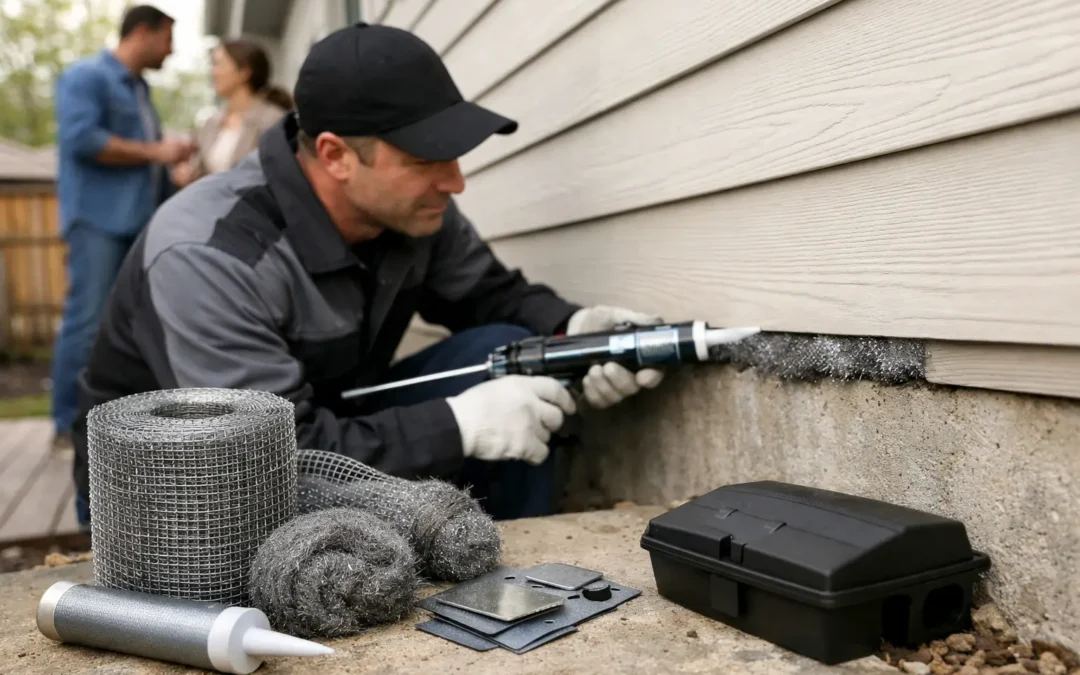
A mouse can slip through an opening about the width of a pencil. Rats need only a little more room. That is why the best rodent proofing materials are not just about stuffing a visible hole with whatever is nearby. They need to resist chewing, weather, heat, moisture, and the regular movement of a home or commercial building.
In Temecula, Murrieta, and nearby valley communities, rodent pressure often increases when outdoor temperatures rise, landscaping changes, or food and water become harder to find outside. Rodents look for shaded wall voids, attic access, garages, utility penetrations, and gaps around rooflines. The right exclusion material closes those entry points for the long term, while the wrong one may create a short-lived patch that rodents work around.
What Makes a Rodent-Proofing Material Effective?
A dependable exclusion repair has to do more than cover a gap. It must be strong enough that rodents cannot chew through it, fitted tightly enough that they cannot push around it, and installed in a way that sheds water rather than trapping it. The material also needs to suit the location.
For example, a flexible sealant works well around a small pipe penetration, but it is not the right answer for a large opening along a foundation vent. A metal patch may stop rodents, but it can fail early if it is not fastened properly or if it allows water into the structure.
The best results come from matching the material to the opening, then addressing the conditions that attracted rodents in the first place. That might include securing trash, reducing birdseed spills, managing pet food, trimming branches away from roof access points, and repairing leaking irrigation or plumbing.
Best Rodent Proofing Materials for Common Entry Points
Galvanized hardware cloth for vents and larger openings
Galvanized hardware cloth is one of the most useful materials for rodent exclusion. It is a welded wire mesh that is far stronger than ordinary window screen and can be cut and shaped to fit foundation vents, crawlspace openings, attic vents, and gaps under certain structures.
For most rodent work, a tight mesh opening is the priority. One-quarter-inch hardware cloth is commonly used because it blocks mice while still allowing ventilation where ventilation is needed. The mesh should be securely fastened with corrosion-resistant screws, washers, or other appropriate hardware. Simply tucking mesh into an opening gives rodents an edge they may pull loose.
Hardware cloth is not a universal solution. On visible areas of a home, it may look unfinished unless installed carefully. It can also rust over time if a low-quality or damaged product is exposed to irrigation, coastal moisture, or runoff. For long-term work, installation quality matters as much as the mesh itself.
Sheet metal and galvanized flashing for chew-resistant repairs
Sheet metal and galvanized flashing are excellent choices for flat gaps, damaged lower siding, holes around garages, and areas where rodents have repeatedly chewed through wood or trim. Metal creates a hard barrier that mice and rats cannot gnaw through.
Flashing is especially useful where different building materials meet, such as the connection between siding and a foundation, behind trim, or around roof and wall transitions. It can be bent to cover irregular areas and tucked into a repair so the edge is not exposed.
The trade-off is that metal repairs must be planned around drainage and movement. A piece installed too tightly in the wrong location can interfere with siding, doors, or expansion joints. Sharp edges also need to be handled and finished carefully. On commercial properties, metal repairs should blend with the building’s function and appearance while still remaining accessible for future inspections.
Copper mesh for small, irregular gaps
Copper mesh is useful around pipes, conduits, cable lines, and other small openings with uneven shapes. It is easy to press into a void, and rodents generally cannot chew through it. It also does not rust in the same way untreated steel wool can.
Copper mesh works best as reinforcement, not as the entire repair. Once it is firmly packed into a gap, a quality exterior-grade sealant can be applied over it to hold it in place and close the remaining edges. This approach is often effective around utility penetrations where a rigid metal patch would be difficult to fit.
Avoid relying on steel wool alone. Standard steel wool can corrode, break down, or be pulled out. It may seem like a fast solution, but it is rarely a lasting one in exterior locations or areas with moisture.
Exterior-grade sealants for narrow cracks and edges
High-quality polyurethane or similarly durable exterior sealants are valuable for narrow cracks, seams, and finishing edges around a stronger barrier. They help close the tiny spaces that rodents can exploit and protect the repair from water intrusion.
Sealant should not be used as the main defense against a rodent-sized hole. Mice and rats can chew many sealants, especially when the material is exposed in a thick, unsupported bead. It performs much better when paired with copper mesh, hardware cloth, flashing, or another chew-resistant material.
Choose a product rated for exterior use and compatible with the surrounding surface, whether that is stucco, masonry, wood, metal, or vinyl. Proper surface preparation matters. Dusty, wet, or loose material can prevent even a good sealant from bonding correctly.
Mortar and concrete for foundation and masonry damage
When rodents are entering through gaps in block walls, deteriorated mortar joints, or damaged areas around a foundation, cement-based repairs are often the right choice. Mortar and concrete provide a durable, chew-proof finish that belongs with masonry construction.
These repairs need a stable base. Filling a deep void with a thin layer of patch material may look complete at first, but it can crack or fall away. For larger openings, a professional may use metal reinforcement or backing material before applying a masonry repair.
Keep in mind that a crack in a foundation or wall can point to a drainage, settling, or maintenance concern beyond rodent activity. Closing the entry point is necessary, but the underlying issue may need attention as well.
Materials That Often Fail Too Soon
Expanding foam is common because it is quick and easy to apply. It can help fill a void before a permanent repair, but by itself it is not rodent proof. Rodents can chew through ordinary foam, and sunlight can degrade exposed foam outdoors.
Caulk alone has the same limitation when used on larger gaps. Wood patches can also fail if their edges remain exposed or if moisture causes them to warp. Plastic vent covers and standard insect screen may keep out insects, but they are usually not built to withstand persistent rodent activity.
Temporary materials still have a place when an opening needs immediate attention. The key is to treat them as temporary and schedule a proper exclusion repair before activity returns.
Installation Matters More Than a Shopping List
Even the best material will not solve a rodent problem if other entry points remain open. A thorough inspection should include the roofline, eaves, attic vents, garage door corners, crawlspace vents, plumbing penetrations, HVAC lines, utility boxes, chimney areas, and the transition between the foundation and exterior walls.
It also helps to understand whether rodents are currently inside. Sealing every opening while rodents are still active in an attic, wall, or crawlspace can create a different problem. A careful plan may include trapping or targeted control first, followed by exclusion and follow-up monitoring.
For homes, the repair should preserve curb appeal and avoid blocking essential ventilation. For businesses, exclusion work should also account for deliveries, dumpster areas, employee entrances, storage rooms, and recurring sanitation conditions. A restaurant, warehouse, office, or multifamily property may have different pressure points than a single-family home.
When Professional Rodent Exclusion Is the Better Choice
DIY repairs can be sensible for a clearly visible, small gap at ground level. But high rooflines, attic access, multiple entry points, damaged vents, and signs of an established infestation are better handled by trained professionals. The goal is not to sell a pile of materials. It is to identify how rodents are getting in, use the right repair for each location, and verify that the building is protected.
At Vineyard Valley Pest Control, rodent exclusion is approached as a practical, local service: inspect the structure, explain the findings clearly, address active activity, and make durable recommendations for the next steps. That gives property owners a clearer path than repeatedly patching the same spot.
A good rodent-proofing repair should let you stop thinking about the hole after it is fixed. If you are seeing fresh droppings, gnaw marks, noises in the attic, or repeat activity around the garage, act before a small opening becomes a larger cleanup and repair job.