
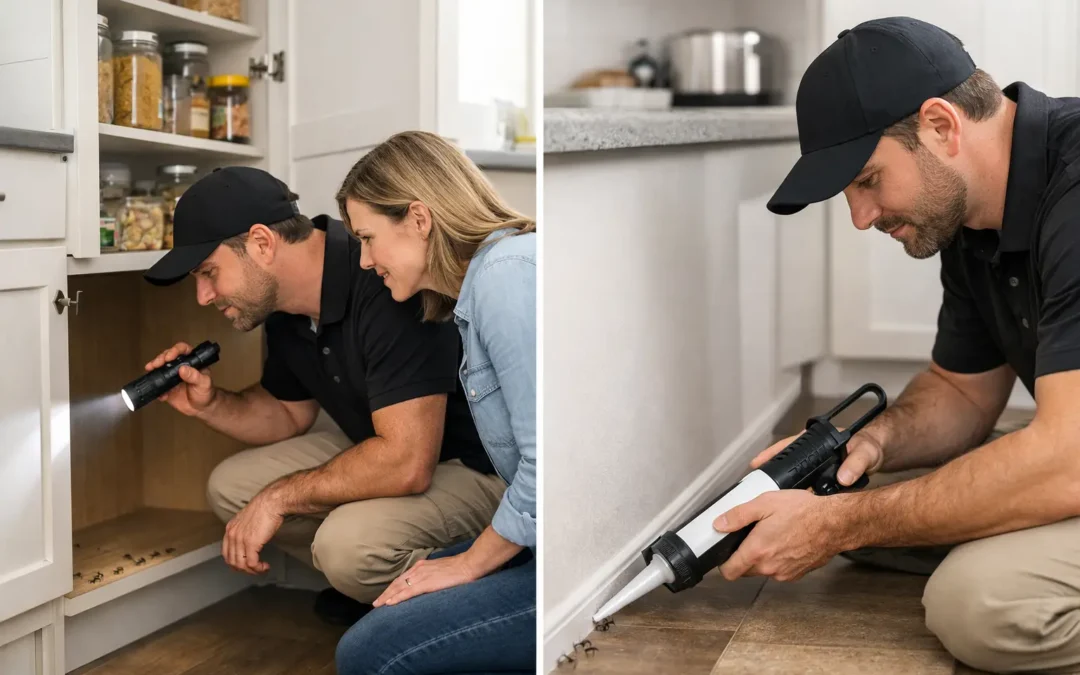
You open the pantry for cereal or coffee, and there they are – a moving line of tiny ants threading along the shelf. If you are wondering how to stop pantry ants, the fix is usually not one big treatment. It is a series of small, smart steps that cut off food, remove trails, and deal with the colony behind the activity.
In Temecula, Murrieta, and nearby valley communities, ant pressure can stay active for much of the year. Warm weather, dry conditions, and irrigated landscapes create a steady reason for ants to move indoors. A few ants in the pantry may look minor at first, but they are often a sign that workers have already found a reliable food source and mapped a route back to the nest.
Why pantry ants keep coming back
Pantry ants are usually not interested in the pantry itself. They are after sugar, grease, crumbs, pet treats, and moisture. Once a scout finds food, it leaves a chemical trail that brings in more ants. That is why wiping away the visible ants without cleaning the trail often leads to the same problem again the next day.
Storage habits also matter. Thin cardboard, loosely folded bags, and containers with worn lids are easy for ants to exploit. Even when food looks sealed, small openings around bag seams or box flaps can be enough. The same goes for items people do not always think about, like drink mix packets, syrup bottles, baking ingredients, and snack bins.
There is also a timing issue. Many homeowners act after the line of ants is obvious. By then, the colony may have been feeding for days. A quick spray might kill the ants you can see, but it can scatter part of the colony or leave the nest untouched.
How to stop pantry ants step by step
The first job is to remove access to food. Take everything out of the affected shelves and inspect it closely. If a package has ants inside, or if the seal is questionable, it is usually best to throw it away. Wiping off the outside of a sticky bottle helps, but if ants are under the cap threads or inside the lid, they will keep returning.
Next, vacuum or wipe up every crumb, grain, and residue from the shelf corners, shelf pin holes, and lip edges. Ants do not need much. A light dusting of sugar or flour can keep them interested. After that, clean the shelves with mild soap and water or a vinegar-water mix to disrupt the scent trail. The goal is not to create a strong smell. It is to erase the path they have been following.
Then transfer pantry goods into hard-sided sealed containers. Clear plastic or glass containers with tight lids work well because they protect food and make it easier to spot future activity fast. This is one of the simplest ways to reduce repeat infestations.
Once the food is protected, watch where the ants are coming from. In many homes, the trail leads to a small crack at the baseboard, a gap around plumbing, a window frame, or the edge of cabinetry. Sealing those openings can help, but timing matters. If you seal too early while ants are still actively using the route, they may simply shift to another gap nearby. It often works better to clean, treat appropriately, and then seal access points after activity drops.
What works better than spraying
For pantry ants, bait is often more effective than contact spray. Sprays can kill the workers you see right away, which feels productive, but many ant problems are driven by the colony hidden behind walls, under slabs, or outside near the foundation. Bait gives worker ants something to carry back, which can affect the nest where the real problem lives.
The catch is that bait only works when it matches what the ants are feeding on. Some species lean toward sweets. Others shift toward proteins or fats depending on season and colony needs. If ants ignore one bait, it does not always mean baiting failed. It may mean the food preference changed.
Placement matters too. Bait should be set near active trails but not directly on food prep surfaces or inside open food storage areas. And once bait is out, avoid spraying over it. If the spray repels or kills the workers before they feed, the bait cannot do its job.
If you use over-the-counter products, read the label carefully and keep them away from children, pets, and food items. More product is not always better. Misapplied materials can spread ants to new areas or make them harder to control.
When the problem is bigger than the pantry
Sometimes pantry ants are only the symptom. The nest may be outside in mulch, under pavers, along irrigation lines, or inside a wall void near plumbing. Southern California properties often have a steady water-food-shelter cycle that supports ant movement from yard to structure and back again.
That is why a pantry-only cleanup may solve the immediate issue but not the full pattern. If ants reappear after you clean and store food properly, there may be an exterior source continually sending in new workers. In those cases, the most effective solution usually combines interior sanitation with targeted exterior treatment and exclusion.
This is especially true when ant activity shows up in multiple rooms, around windows, in bathrooms, or along the kitchen perimeter rather than just on one pantry shelf. At that point, you are dealing with a broader access issue, not just a spilled bag of sugar.
Common mistakes that keep pantry ants active
One of the biggest mistakes is relying only on store-bought spray. It gives fast knockdown, but often not lasting control. Another is leaving pantry items in original packaging after the first infestation. If ants found those items once, they will check them again.
People also tend to miss secondary food sources. Trash can residue, recycling bins, toaster crumbs, pet food containers, and the sticky ring under a honey bottle can all keep ants nearby. Even under-appliance debris can contribute.
Moisture is another overlooked factor. A small leak under the sink, condensation near a window, or dampness around a refrigerator line can make the area more attractive. Ant control works better when food and water pressure are reduced together.
How to stop pantry ants long term
Long-term control is really about changing the conditions that support ant activity. Keep dry goods in sealed containers, wipe shelves regularly, and do not let spills sit overnight. Rotate older pantry items forward so forgotten food does not become a hidden source.
It also helps to look beyond the pantry. Trim vegetation away from the house, reduce heavy mulch against the foundation, and watch for ant movement near door thresholds, window frames, and utility penetrations. If there are cracks or gaps, seal them once the active trail is under control.
For homes and businesses that deal with recurring ant pressure, routine service can make a big difference. Ongoing treatment is not about constant chemical use. It is about monitoring, addressing seasonal shifts, and stopping small issues before they turn into repeated indoor activity. That is often the practical choice in areas where ant pressure stays persistent.
When to call a professional for pantry ants
If you have cleaned thoroughly, switched to sealed storage, tried bait correctly, and the ants keep returning, it is time for a closer inspection. The same goes for heavy activity, repeated infestations, or ants showing up in several parts of the property.
A licensed pest control professional can identify likely nesting zones, entry points, and species behavior that affects treatment choice. That matters because not all ants respond the same way, and the wrong product in the wrong place can slow down control instead of helping it.
For local homeowners and property managers, that kind of targeted approach usually saves time and frustration. Companies such as Vineyard Valley Pest Control work with the realities of this area – warm seasons, dry landscapes, irrigated yards, and the kind of repeat ant pressure many valley properties see year after year.
Pantry ants are frustrating, but they are usually beatable when you stop feeding the trail, protect stored food, and treat the source instead of just the symptoms. If the line keeps coming back, do not assume you are doing something wrong. It may just mean the colony is established somewhere that takes a more direct plan to reach.